

2025 Layoffs Tracker: Jobs Cut, Top Companies, Bankruptcies
2025-11-24
Layoffs in 2025 so far — how many jobs have been cut, who’s leading the cuts, bankruptcies, and what it means for workers and industries
Executive summary
2025 has been a heavy year for workforce reductions. Independent trackers and press tallies put tech-sector layoffs in the hundreds of thousands and corporate bankruptcy filings at multi-hundred levels worldwide. Estimates vary by source and by whether the count is global or US-only — but readers should expect that 2025’s layoffs exceed the worst weeks of 2024 and that large multinational tech, retail and travel firms account for many of the biggest single-company reductions.
How many employees have been laid off in 2025 (so far)?
There is no single universal counter; different trackers measure different universes (global vs. US, tech-only vs. all industries). Here are representative, widely-used tallies:
• Tech-sector trackers: Layoff trackers focused on tech report tens of thousands to low hundreds of thousands of tech employees affected in 2025. For example, a tech layoffs tracker shows roughly ~200,000 tech roles impacted in 2025 (tech category).
• Press tallies: Crunchbase/BizInsider style tallies put >100,000 tech jobs cut in the U.S. alone by late 2025 and report big weekly spikes (e.g., one week saw ~17,000 U.S. tech layoffs).
• Aggregate view: Broader trackers and news aggregations counting layoffs across industries report many hundreds of thousands of job cuts across sectors in 2025 when retail, travel, manufacturing and services are included. (See S&P/Market Intelligence on rising corporate bankruptcies alongside layoff trackers.)
• What to take away: exact totals vary by methodology. Reasonable, evidence-backed ranges: 90k–200k tech layoffs globally (multiple trackers), and >100k–300k total corporate layoffs across sectors by late 2025 when combining public announcements and filings.
Companies leading layoffs in 2025 — ranked by employee numbers (largest publicly reported rounds)
Below are major, well-reported reductions in 2025 with source links. Many companies executed multiple rounds; I show reported numbers or credible ranges where reporting differed.
Amazon — reported target: up to ~30,000 corporate cuts; initial reported rounds 14,000+; Reuters frames 30,000 as “many” and says it would be nearly 10% of Amazon’s corporate workforce (~350k corporate staff) while being a small share of its 1.55M total workforce. (largest single-company number reported in 2025).
Microsoft — reported ~6,000 layoffs (May 2025) and broader announcements that could bring totals higher across the year; AP reported ~6,000 in one round.
Major telecom, finance and retail names (various rounds) — Verizon, IBM, Starbucks, large airlines and retail chains reported multi-thousand reductions in specific functions or store closures across the year; Business Insider and regional press ran aggregated lists showing many companies with cuts in the thousands.
Confidence & caveats: Amazon’s 30,000 figure is reported by Reuters and widely cited; some outlets report lower round-by-round numbers (e.g., 14,000 in initial phases). Microsoft’s 6,000 is reported by AP and others. Many other corporations ran multiple smaller rounds whose totals add up but are reported in separate stories — that’s why aggregate trackers show larger cumulative totals than any single news story.
Companies leading layoffs in 2025 — ranked by % of workforce impacted
Percent-based ranking is sensitive to how “workforce” is defined (global vs. corporate vs. specific division). Below are notable percent impacts where reporting provided both a cut number and the relevant workforce base:
Amazon (corporate population) — up to ~10% of Amazon’s corporate workforce (if 30k cuts affect ~350k corporate employees) — Reuters frames the 30k figure as nearly 10% of corporate staff. Against Amazon’s full headcount (~1.55M), the percent is much smaller (~1–2%).
Microsoft — ~2–3% of ~228k global employees (6,000 layoffs ≈ 2.6%).
Smaller public/VC-backed tech firms — Several smaller companies and startups reported double-digit percentage workforce cuts (15–30%+) in 2025; these high-percent rounds appear more often at smaller firms where headcounts are lower and single rounds represent larger percent changes. See multiple trackers and company filings.
Important: Percent rankings tend to elevate smaller firms (a 200-person firm cutting 40 roles looks larger as % than a 30,000 cut at a multinational). Use both absolute numbers and percent to understand scale vs. severity.
Companies that filed for bankruptcy or shut down in 2025
2025 saw a surge in corporate insolvencies in some jurisdictions. Below are notable, well-reported bankruptcies and permanent shutdowns (examples across retail, fashion, health and more):
• Forever 21 — bankruptcy protections and major restructuring actions were widely reported in 2025 for Forever 21’s U.S. operations (liquidations/US store exits covered in press).
• Rite Aid, Claire’s, other legacy retail & fashion names — several well-known retail chains filed Chapter 11 or similar proceedings in 2025 as the retail sector continued to contract.
• Consumer biotech / direct-to-consumer brands — a handful of consumer health/biotech firms (e.g., 23andMe) and some D2C startups sought restructuring or protection in 2025. (See category of Chapter 11 filings.)
• Numerous private companies and local chains — S&P Market Intelligence reported a spike in corporate bankruptcies (371 filings in H1 2025 in their counted cohort), the highest pace since 2010 for comparable samples.
• Why this matters: bankruptcies typically lead to permanent job losses for many employees (store closures, liquidation), and often shift remaining roles to a much smaller base post-restructuring.
Companies struggling to break even / on the verge of shutdown
“Going-concern” warnings and near-bankruptcy signals were common in 2025 across capital-intensive sectors and low-margin retail:
EV start-ups — Several EV makers continued to burn cash with uncertain near-term profitability (Lucid, Rivian, Fisker and smaller EV names have been flagged for large cash burn and going-concern risks). Journalism and industry reports flagged a number of EV firms as struggling to reach break-even at scale.
Solar contractors and installers — a wave of small/medium solar installers and contractors reportedly went out of business or filed insolvency in 2024–2025 as financing and margin pressures rose. (Sector trackers list multiple local failures.)
Fashion & brick-and-mortar retail — many traditional retailers are still shrinking: store closures, impaired cash flows and failed turnaround attempts put several chains near collapse in 2025.
Smaller startups in ad-tech, crypto and marketplaces — a steady stream of mid-stage startups warned of funding shortages and posted “going concern” language — these are signals of imminent restructuring or shutdown risk. (See sector press and bankruptcy trackers.)
Which industries saw the highest layoffs in 2025?
Based on trackers and industry coverage, the highest layoffs by volume and frequency were concentrated in:
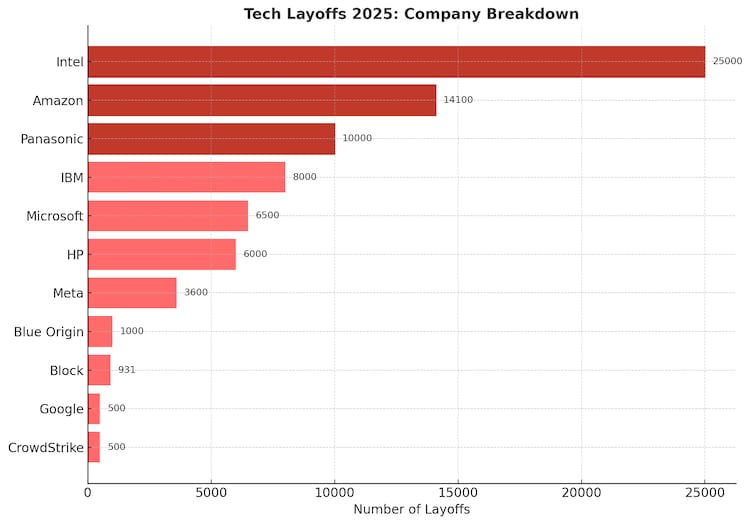
Technology & software (including adtech, consumer apps, cloud teams) — heavy and frequent rounds; trackers focused on tech show the largest single-sector totals.
Retail & e-commerce (store closures + corporate cuts) — store shutdowns and restructuring lead to both large permanent closures and staff cuts.
Travel, hospitality & airlines — restructuring and route rationalizations triggered layoffs and asset sales in pockets; some airlines entered restructuring.
Automotive / EV startup cluster — high cash burn caused layoffs and warnings in EV startups; legacy OEMs also trimmed certain teams.
Media & streaming — shifting monetization models (AVOD / subscription convergence) produced waves of role consolidation and production rebalancing.
What layoffs mean for employees — short and longer term
• Immediate financial stress: sudden loss of income, health/benefit disruptions and relocation upheaval are common. Severance can help but varies widely by company and country. For hourly/store staff, severance is often limited. (See repeated coverage of Amazon/Microsoft/retail rounds for employee impacts.)
• Re-skilling pressure: many laid-off employees are pushed to retrain quickly — AI-adjacent roles, cloud skills and data roles remain in demand; however, supply of talent is high, meaning reemployed roles may pay less than prior positions. Industry press and analysts emphasize reskilling programs but also note imperfect labor-market absorption.
• Geographic & immigration implications: cross-border workers (e.g., visa holders) face immediate visa/immigration pressure when laid off, increasing personal stress and costs. News reporting on U.S. tech layoffs documented this repeatedly in 2025.
• Wider mental health & community impacts: LinkedIn and social coverage show elevated anxiety and increases in career-transition services demand. Employers that offer career transition, reskilling grants and job-placement assistance reduce downstream damage to employees.
What it means for industries & the economy
• Productivity & reallocation: layoffs can accelerate reallocation of talent to growing sub-sectors (AI/ML, healthcare tech, green infrastructure) — but widescale structural unemployment in some regions is a risk if demand doesn’t absorb displaced workers quickly.
• Innovation & investor caution: big layoffs and bankruptcies lead investors to tighten due diligence and prioritize capital discipline; early-stage funding across risky categories (EV, adtech, some consumer startups) slows as a result.
• Consumer demand: retail closures and job losses in local markets can depress consumer spending and create negative feedback loops for local economies where job losses concentrate.
Quick list — notable 2025 examples
Amazon — large corporate cuts reported up to ~30,000 (reporting shows different phase counts; Reuters coverage).
Microsoft — ~6,000 roles cut in a reported round (AP reporting).
Google / Alphabet — hundreds to low thousands across several divisions in multiple rounds (The Information, Reuters reporting).
Smaller tech and startups — many double-digit percent reductions (see Layoffs.fyi / trueup trackers).
Retail chains & fashion brands — Forever 21, Rite Aid and others cited in corporate insolvency coverage and retail bankruptcy trackers.
EV & capital-intensive startups — Rivian, Lucid, Fisker and similar EV firms flagged for cash burn / going concern risks.

What employers and policymakers should do now
Employers: adopt transparent communication, fair severance, outplacement programs and reskilling budgets; partner with local retraining providers.
Policymakers: expand unemployment insurance coverage where possible, support retraining subsidies in high-demand fields, monitor visa/immigration impacts for cross-border workers.
Jobseekers: prioritize transferable skills, update networks, consider contract / consulting bridge roles while reskilling into growth areas (cloud, AI tooling, healthcare IT, infra).

Stay updated with our latest news and articles. Join our newsletter!
Trending Now
No trending posts found.
Related Articles
Debug: Tags used: ayoffs 2025,2025 job cuts,Amazon layoffs 2025,Microsoft layoffs 2025,tech layoffs 2025,company bankruptcies 2025,retail bankruptcies 2025,EV startups struggling,industries hitting layoffs,what layoffs mean for employees,layoff tracker 2025