
Types of Mutual Funds: Understanding Where and How to Invest
2026-09-15
As a beginner, if you are curious about how to grow your money, the answer is investing in mutual funds. It is safe, low-risk, and requires no active effort. For a first-time investor, that sounds wonderfully simple: put money into a mutual fund, let professionals manage it, and wait for the investment to grow.
But there is an important distinction between investing and investing intelligently. Even if it is an easy way, you need to understand what you are buying because not all mutual funds invest in the same assets. And this is where many new investors make their first mistake: selecting a mutual fund with recent attractive returns because someone recommended it, or because the name sounds safe. Let us even compare two of the world's major investment markets: India and the United States.
Exploring Types of Mutual Funds for Beginners' Understanding
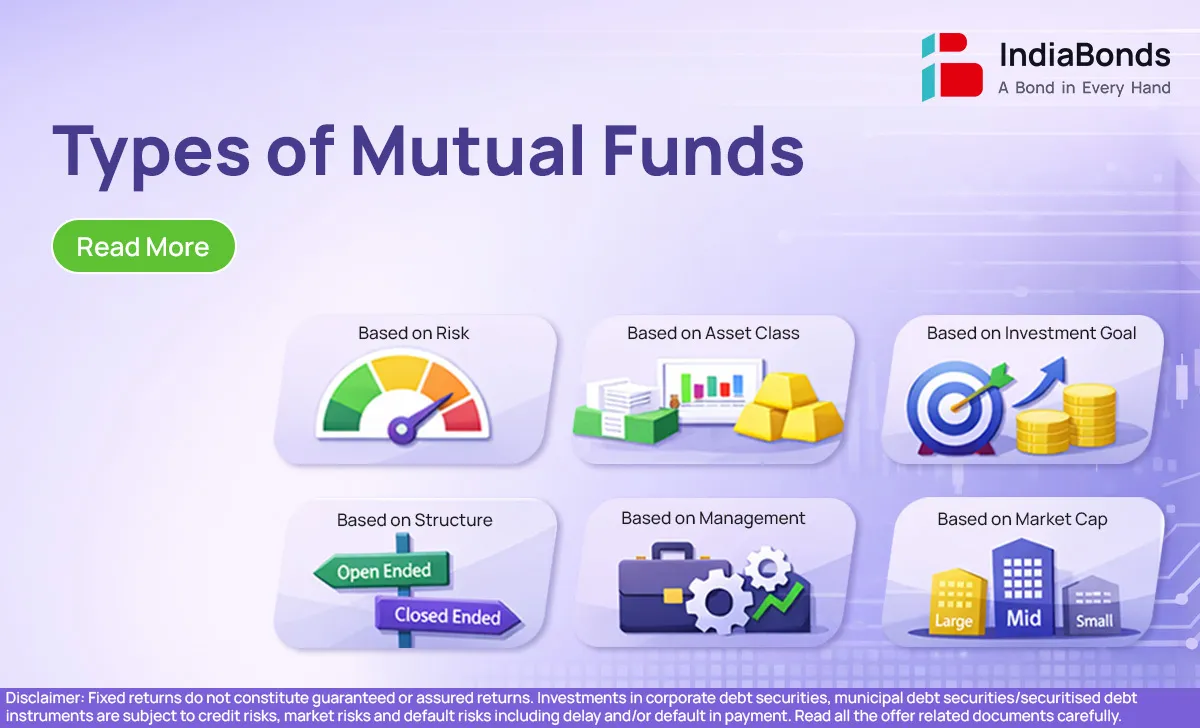
Types of Mutual Funds in India
India's mutual-fund framework is regulated by the Securities and Exchange Board of India (SEBI). SEBI's current framework broadly classifies schemes into equity, debt, hybrid, life-cycle and other schemes, with further subcategories.
Equity Mutual Funds
These are primarily invested in stocks and equity-related instruments, generally intended for investors seeking long-term capital growth and who can tolerate market volatility. The important distinction is that the different funds of these do not all carry the same level of risk. A small-cap fund, for example, focuses on smaller companies, while a large-cap fund focuses on larger companies.
Debt Mutual Funds
Debt funds primarily invest in fixed-income instruments such as government securities, corporate bonds, and money-market instruments. Considered low-cost mutual funds and are good mutual funds to invest in, as they are short-term investments and low risk, provided you check the average mutual fund return history. These funds can be useful for investors seeking exposure to fixed-income markets, although debt funds are not risk-free. Credit risk and interest-rate risk can affect their value.
Hybrid Mutual Funds
Hybrid funds are good mutual funds to invest in that combine different asset classes. Depending on the category, a fund may combine equities, debt, and other permitted assets. The basic idea is diversification across asset classes rather than concentrating the entire portfolio in equities or debt.
Life-Cycle/Solution-Oriented Funds
These funds are designed around specific long-term objectives. Hence, they are based on financial goals, making the investment decision more meaningful. Indian mutual fund classifications include retirement funds and children's funds.
Index Funds and ETFs
These are another low-cost mutual fund in India offering passive investment products that track an index rather than attempting to outperform it through active security selection. SEBI's current classification places index funds and ETFs within the broader “Other Schemes” category.
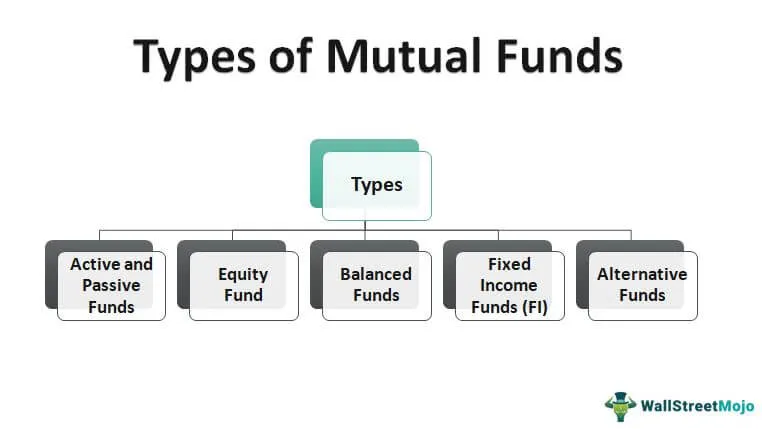
Types of American Mutual Funds
The U.S. mutual-fund market uses somewhat different terminology. The SEC's Investor.gov broadly identifies the following among the major mutual-fund categories.
Stock Funds
Stock funds primarily invest in equities, which can focus on different parts of the market. Because stock prices can fluctuate considerably, stock funds can experience significant short-term volatility.
Bond Funds
Bond funds are not equivalent to holding an individual bond until maturity. Their values can change as interest rates, credit conditions, and other market factors change. Bond funds primarily invest in debt securities; hence can be a good mutual fund to invest in.
Money-Market Funds
This category is often used by investors seeking a relatively conservative place for cash within the investment market. Money-market funds are best low-cost mutual funds for beginners as they invest in liquid, short-term debt securities, cash, and cash equivalents. They generally carry lower risk than many other mutual-fund categories, but historically have also offered lower returns.
Balanced Funds
Balanced funds are open-ended funds combining different asset classes for potential growth with diversification and income on investments. A common example might be a portfolio with approximately 60% stocks and 40% bonds, although allocations can vary between funds.
Target-Date Funds
Target-date funds generally hold a mixture of funds and other investments, particularly associated with retirement investing in the U.S. Their asset allocation is designed to become more conservative as the target date approaches, so many beginners are advised to take it slow on these. For example, someone planning to retire around 2055 might select a 2055 target-date fund. The fund then manages the asset allocation over time according to its investment strategy.
Index Funds
Index funds seek to track a particular market index rather than actively selecting securities with the primary goal of beating that benchmark. For beginners, it's always advisable to invest in low-fee index funds. The SEC notes that an index fund can be structured as a mutual fund or ETF and seeks to track the returns of its chosen index.
India vs America: Mutual Fund Types Compared
Investment Type | India | America | Basic Investment Idea | Key Benefits | How to Invest |
Equity/Stock Funds |
|
| Invest primarily in stocks |
|
|
Debt/Bond Funds |
|
| Invest primarily in debt securities |
| Compare:
|
Hybrid / Balanced Funds |
|
| Combine:
|
| Select according to:
|
Money-Market Funds |
|
|
|
| Consider:
|
Target-Date/Life-Cycle Funds |
| Widely used for retirement |
|
|
|
Index Funds |
|
| Passively track a market index |
|
|
Sector/Thematic Funds |
|
| Concentrate on a particular industry or investment theme |
| Use only when the concentrated exposure fits your overall portfolio and risk tolerance |
Gold/Commodity Exposure |
|
|
|
| Understand:
|
Fund of Funds (FoF) |
| Funds that invest in other funds | Invest through other investment funds |
| Examine:
|
What Beginners Need To Understand About Mutual Funds Investment
The biggest thing to understand: it's not always about the good mutual funds to invest in, but also about the objective of investment. So instead of thinking “Which mutual fund gives the highest return?”
begin with the following
- Goal: One needs to understand their goal for investment is it long term, short term, for retirement, to build a diverse portfolio, for education, to buy a home, or for wealth creation.
- Time Horizon: Gauge your timeline and decide how long you can stay invested. Is it a three-year goal and a 20-year goal because each requires very different approaches?
- Risk: Then one needs to consider the amount of risk they can sustain. Equity funds can experience substantial short-term fluctuations, while debt and money-market funds generally have different risk and return characteristics, so one needs to know how much volatility I can tolerate.
- Asset Class: Just finding the good mutual funds to invest in is not enough; one should know what is actually inside it, i.e the type of investment that the fund buys so you understand where your money is really going.
- Fund: Investing requires funds, so you need to assess expense ratios, sales charges, transaction costs, and other fees that can affect long-term returns.
A structured approach can help avoid choosing funds solely on recent performance.
Mistakes To Avoid While Investing In Mutual Funds

Comparing Funds:
- A common mistake is to compare two funds simply because they appear to belong to the same broad category.
- For example: An Indian large-cap fund is not automatically identical to every U.S. large-cap fund.
- The underlying securities, market conditions, taxation, currency exposure, regulations, fees, and investment strategy can all differ, so one should look beyond the category label.
Mixing Active & Passive Investments:
- One should consider this another layer that applies across both markets.
- A fund can be actively managed, where the manager selects investments according to the fund's strategy, or it can be passive, where the fund seeks to replicate an index.
- Neither label automatically makes a fund “better.” The only consideration is that it should suit your objective, costs, and have acceptable risk.
Mutual Funds Are Shortcuts
- People need to understand that mutual funds can make investing easier; they are tools and not shortcuts.
- They provide access to professionally managed, diversified portfolios. But diversification does not eliminate investment risk, and past performance does not guarantee future results.
Conclusion: Don't Just Invest in Mutual Funds, Understand What You Own
Be it American mutual funds or Indian investing is made accessible to millions of people because they allow investors to participate in diversified portfolios without having to select every security themselves. But accessibility should not be confused with simplicity. Each country has its own mutual funds; the names may differ, but the fundamental lesson remains the same:
Investing is only the first step. Understanding where your money goes is what makes the decision meaningful. Do good mutual fund to invest in is not necessarily the one that topped the average mutual fund return history last year. It is the one whose investment objective, risk, cost, strategy, and time horizon make sense for you and your financial goal.
Investing in Mutual Funds for beginners is overwhelming, but knowing the basics and a understand about Indian and American options, you have with what benefits they give, can be helpful. So keep reading Micromunch for more such investment articles.
P. Manika (Performist Content Writer)
Disclaimer: For informational purposes only, based on publicly available sources and not firsthand experience. The author is not a licensed financial advisor, and this is not professional financial advice.
Source:
https://groww.in/p/types-of-mutual-funds

Stay updated with our latest news and articles. Join our newsletter!
Trending Now
No trending posts found.