
Trump’s Tariffs and the U.S. Economy: One Year In, Gains, Risks, and What Comes Next
2025-12-15
By the Numbers: One Year of Trump’s Economic Reset
Nearly a year after Donald Trump returned to the White House, the U.S. economy is absorbing the shockwaves of a renewed “America First” agenda—one centered on tariffs, trade confrontation, and industrial reshoring. The early results are neither the collapse critics warned about nor the renaissance supporters promised.
Instead, the data tell a more complicated story: modest growth, selective trade improvements, rising costs for consumers, and a deepening divide between sectors that benefit from protection and those that suffer from retaliation.
Tariffs as Strategy, Not Tactic
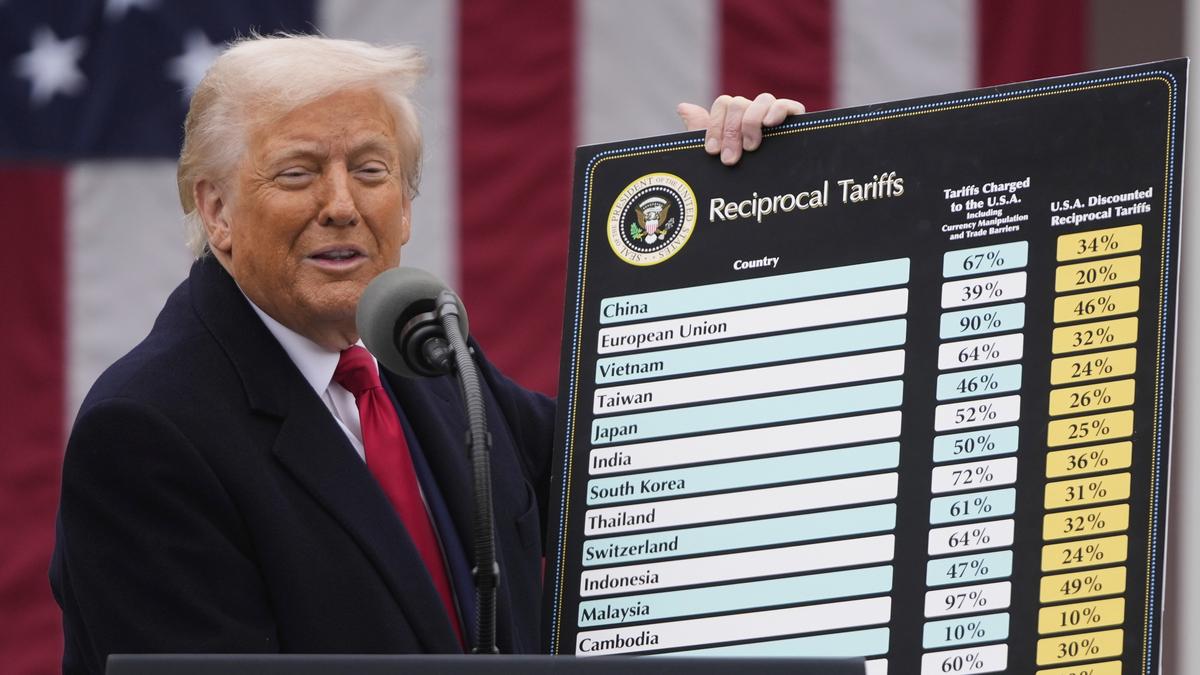
President Donald Trump during new tariffs announcement event in the Rose Garden at the White House, Wednesday, April 2, 2025, in Washington, D.C. | Photo Credit: AP
Trump’s second-term tariff push is broader and more aggressive than his first. Import duties on Chinese goods, renewed pressure on North American trade partners, and threats against European exports are not designed as temporary leverage. They are structural.
Administration officials argue tariffs are meant to rebuild domestic supply chains, reduce strategic dependence on foreign producers, and force companies to manufacture inside U.S. borders—even if the transition is painful.
The White House sees tariffs less as a tax and more as an investment in long-term resilience.
Short-Term Reality: Slower Growth, Higher Prices
In the near term, the costs are visible.
Economic growth has cooled compared with previous years, reflecting weaker business investment and uncertainty around trade rules. Tariffs have raised the price of imported components and finished goods, pushing costs higher for manufacturers and consumers alike.
While inflation has not surged uncontrollably, tariff-driven price pressures are evident in consumer goods, industrial inputs, and agriculture-related products.
Businesses exposed to global supply chains—autos, electronics, heavy machinery—remain cautious on hiring and capital expansion.
Trade Balance Improves—but at a Cost
One area Trump highlights frequently is the narrowing trade deficit. Export volumes have risen in select sectors, and imports have declined as tariffs bite. On paper, the numbers support the administration’s claim that the U.S. is importing less and producing more at home.
But the improvement has come with trade-offs. Retaliatory tariffs from foreign governments have hit U.S. farmers and exporters, requiring billions in federal aid to offset lost markets. Critics argue the government is effectively recycling tariff revenue to compensate for tariff damage.
Winners and Losers
Who benefits so far:
Domestic steel and certain manufacturing segments
Firms positioned to replace imports
Workers in protected industries
Who is under pressure:
Farmers reliant on export markets
Import-dependent manufacturers
Consumers facing higher prices
Small businesses unable to absorb cost increases
The result is an uneven economy—resilient in pockets, strained in others.
The Long Game: Resilience vs. Efficiency
The core debate surrounding Trump’s policies is not about short-term performance, but long-term structure.
Supporters argue that decades of globalization hollowed out American manufacturing and left the U.S. vulnerable to geopolitical shocks. Tariffs, they say, force a correction—one that may slow growth today but strengthen national capacity tomorrow.
Critics counter that protectionism reduces efficiency, discourages innovation, and ultimately lowers overall prosperity. They warn that prolonged trade conflict risks isolating the U.S. while competitors adapt faster.
Both sides agree on one thing: the outcome will not be clear for years.
Who’s Behind the Policies
Trump remains the chief architect, but the framework is shaped by:
1.Economic nationalists advocating industrial self-sufficiency
2. Trade advisers skeptical of multilateral agreements
3. Policy veterans who see tariffs as leverage, not ideology
The approach prioritizes sovereignty and control over global integration—a sharp contrast to the free-trade consensus that dominated U.S. policy for decades.
Bottom Line
After nearly a year, Trump’s economic strategy has changed the direction of the U.S. economy, but not yet transformed it.
The economy is not collapsing—but it is slower, more insulated, and more politically charged. Whether that trade-off produces a stronger, more resilient America—or simply a more expensive one—depends on whether domestic production can scale fast enough to replace what globalization once delivered cheaply.
For now, Trump’s bet remains exactly that: a bet on long-term strength at the cost of short-term friction.

Stay updated with our latest news and articles. Join our newsletter!
Trending Now
No trending posts found.